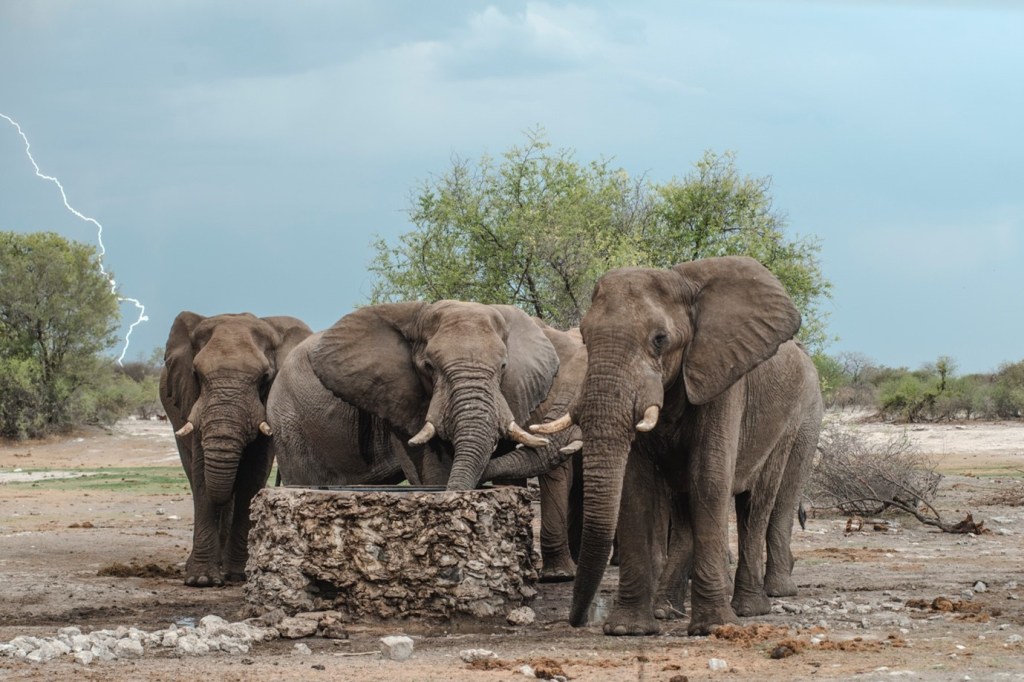
“In Namibia you must take time.” Says Johannes. It hasn’t even been a week since I left the autumnal nip of Wageningen for the arid landscape of Tsumkwe, but I have somehow found myself chatting with two travelling electricians over a few shots of Jägermeister. Under a star speckled night sky a herd of elephants drifts to the nearby borehole while we watch.
“My friend, time is everything,” Johannes continues. “When you marvel at these elephants you think it is their tusks you appreciate. But you are connecting to the time it takes to grow what makes each elephant beautiful and unique.” These half-drunk musings hide wisdom beyond the theories of the classroom, and it suddenly strikes me that my internship in Tsumkwe, Namibiamarks the start of a complete and rounded education.
Tsumkwe would never make the list for top ten Namibian experiences. It is a harsh and poorly connected landscape not without its own complications in development. Yet, here I am, driven by my belief that community-driven indigenous aspirations of development can spur meaningful perspectives necessary to decolonise a field with a troubled history of “intervention” and “progress.”
Even with two years of prior experience under my belt, my internship in Tsumkwe with indigenous-entrepreneur Leon Tsamkgao is a masterclass in international development. It affords me the opportunity to bridge the lessons of my classroom at Wageningen with the shifting ground realities of what the development practitioners of yesteryear would carelessly label as ‘the field’.
Working in collaboration with Leon, I learn more about what development aspirations indigenous groups such as the Ju/’hoansi desire. More importantly, I have begun to understand what unique perspectives a single indigenous group can contribute to the field of international development. From a largely peaceful coexistence with wildlife to a profitable indigenous conservancy quickly finding its pace under the disputed promises of community-based-natural-resource-management, there is an abundance of lessons to learn.

Yet, these lessons aren’t always sweet. I have also learned that addiction, alcoholism, displacement, and a loss of traditional knowledge run hand-in-hand with other ill-informed notions of development thrust by careless parties under the yoke of “modernisation”. These are challenges I might have learned in the classroom, but never could have understood fully until my placement in Tsumkwe. Nevertheless, these are the troubling juxtapositions a complicated field like development studies involves. As I grapple with my own positionality in this dynamic and charged place, I am reminded that this is why development studies matters; this is why an internship here is so pivotal.
However, the depth of what my internship in Namibia continues to offer me extends far beyond the sharp confines of academia, critical reflection and career progression. Far from Europe and the fast-paced impermanence of Zygmunt Bauman’s liquid modernity, I spend my time in Tsumkwe with a surplus of Johannes the Electrician’s coveted ‘time’.
Here there is time to reflect. Time to talk. Time to meet new and engaging people. I am told that “only interesting people pass Tsumkwe,” and this I believe to be true. I have met no shortage of fascinating faces. I have chatted with archaeologists, engineers, indigenous animal trackers, healers and even a champion World Cup rugby player. I have found the ground to peaceably converse with victims of addiction, apartheid-apologists, and right-wing evangelists. Each conversation leaves an indelible impression on my growth and roundedness as a human being — And perhaps successful “development” requires fewer policy makers and more human beings. Less theory and more empathy.

Namibia is not without its challenges. At times it is a struggle. At times I yearn for the comfort of Sri Lankan familiarity. Yet at all times I am aware that my internship in Namibia marks the beginning of a new and exciting chapter in my life. Like all good stories it will have its share of challenges and breakthroughs. Victories and failures. Denouement and character-arcs as novelists would put it.
I never met Johannes the Electrician again. I probably never will. But the wisdom of his half-drunk musings rings true. My internship in Tsumkwe is much more to me than simply learning international development à là “the hands-on approach”. It is a union of classroom theory with the everyday lived experiences of Tsumkwe. The culmination of lectures and prior career experience with a dynamic place where community-led indigenous development is taking the fore. It is the sum total of the wisdom in all the exchanges I have with the interesting people with whom I cross paths.
It is holistic. It is time.
The above reflection was a piece I wrote to Wageningen University & Research for the chair-group Sociology of Development & Change during my MSc International Development Studies internship component
 sandeshbartlett.media
Leave a comment